
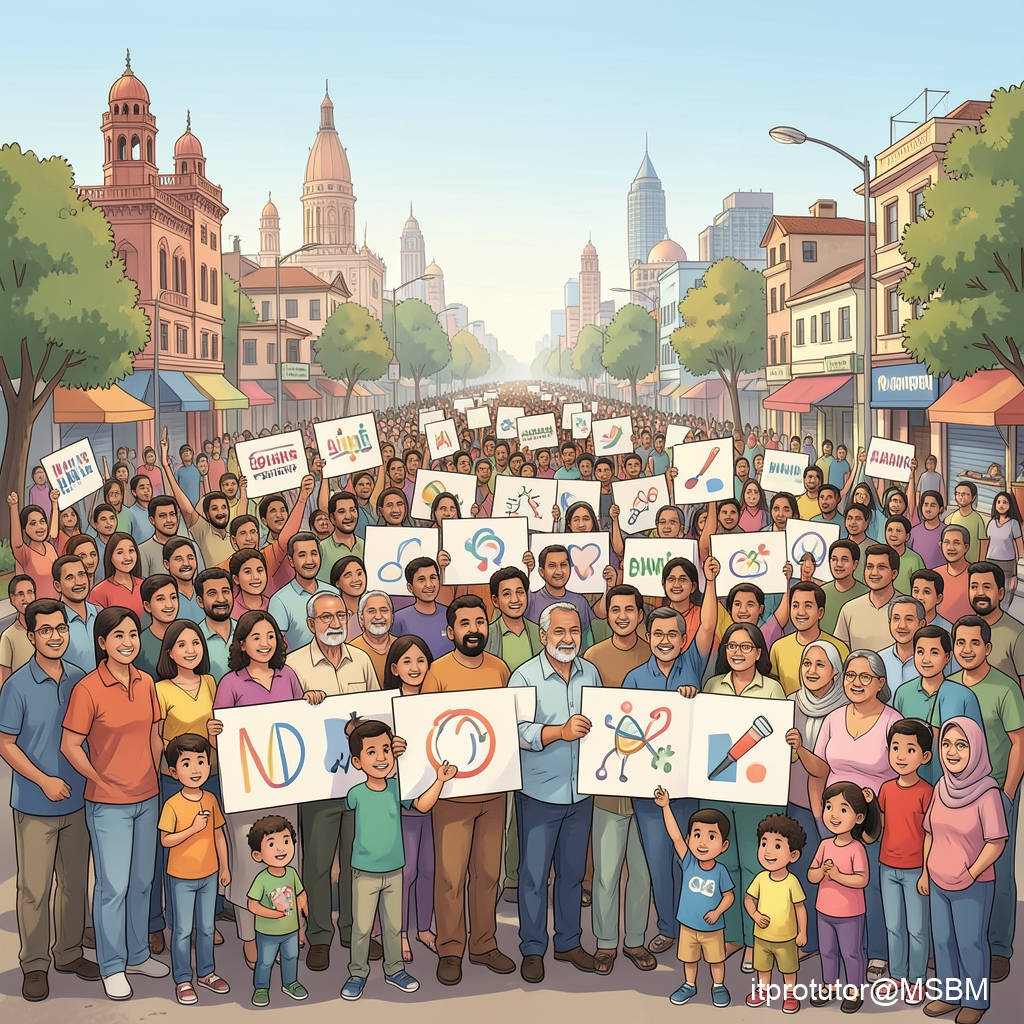
What happens when a real-world social movement bypasses traditional media algorithms to unite an entire nation?
In a powerful letter to *The Guardian*, reader Bhaskar Mani highlights how India’s Gen Z-led “Cockroach Janta Party” (CJP) protests transcended demographic boundaries. Far from being an isolated youth revolt, the peaceful movement rallied cross-generational support from parents, grandparents, and working professionals across major metropolises and small towns—even as mainstream media suppressed and distorted the narrative.
This dynamic vividly illustrates **Decentralized Network Theory** and highlights the limits of **Media Hegemony** (Gramsci). When centralized information nodes (traditional media outlets) filter or censor critical signals, grass-roots networks naturally reorganize to disseminate truth and mobilize collective action. The CJP movement reflects deeper anxieties over fading democratic structures and shrinking economic prospects, proving that modern public spheres can operate independently of legacy channels.
However, this raises a crucial question for the digital age: As physical and digital public spaces face increasing suppression, can decentralized, social-media-driven movements translate temporary network effects into long-term political reform without formal institutional leverage? How do we protect democratic discourse when traditional gateways fail to reflect reality?
—
當傳統媒體的過濾機制失靈,實體世界的「去中心化網絡」如何爆發出撼動國家的集體力量?
根據 Bhaskar Mani 投書至《衛報》的內容,印度 Z 世代發起的「蟑螂大眾黨」(CJP)和平抗議運動打破了年齡與階級藩籬。這場運動不僅僅是年輕人的反抗,更獲得了跨世代(包含祖父母與職場菁英)在各大城市的廣泛支持,即使主流媒體選擇封鎖真相甚至扭曲報導。
從資訊系統與社會學的角度來看,這現象完美契合了**去中心化網絡理論(Decentralized Network Theory)**與葛蘭西的**媒體霸權(Media Hegemony)**概念。當中心化的資訊節點(傳統媒體)對數據進行過濾與壓制時,分散式的群眾網絡便會自我組織,成為傳遞真相與集體行動的新渠道。這反映出人民對民主衰退與經濟困境的集體焦慮。
然而,這引發了一個值得深思的科技與社會議題:在演算法審查與訊息戰日益嚴重的數位時代,缺乏傳統制度支持的「去中心化數位公眾領域」,究竟該如何將一時的網絡效應轉化為持久的體制改革?當權力結構試圖掌控資訊流時,我們又該如何維護真實的民主對話?
#CollectiveAction #MediaHegemony #GenZMovement #ITProTutor
Source: The Guardian