
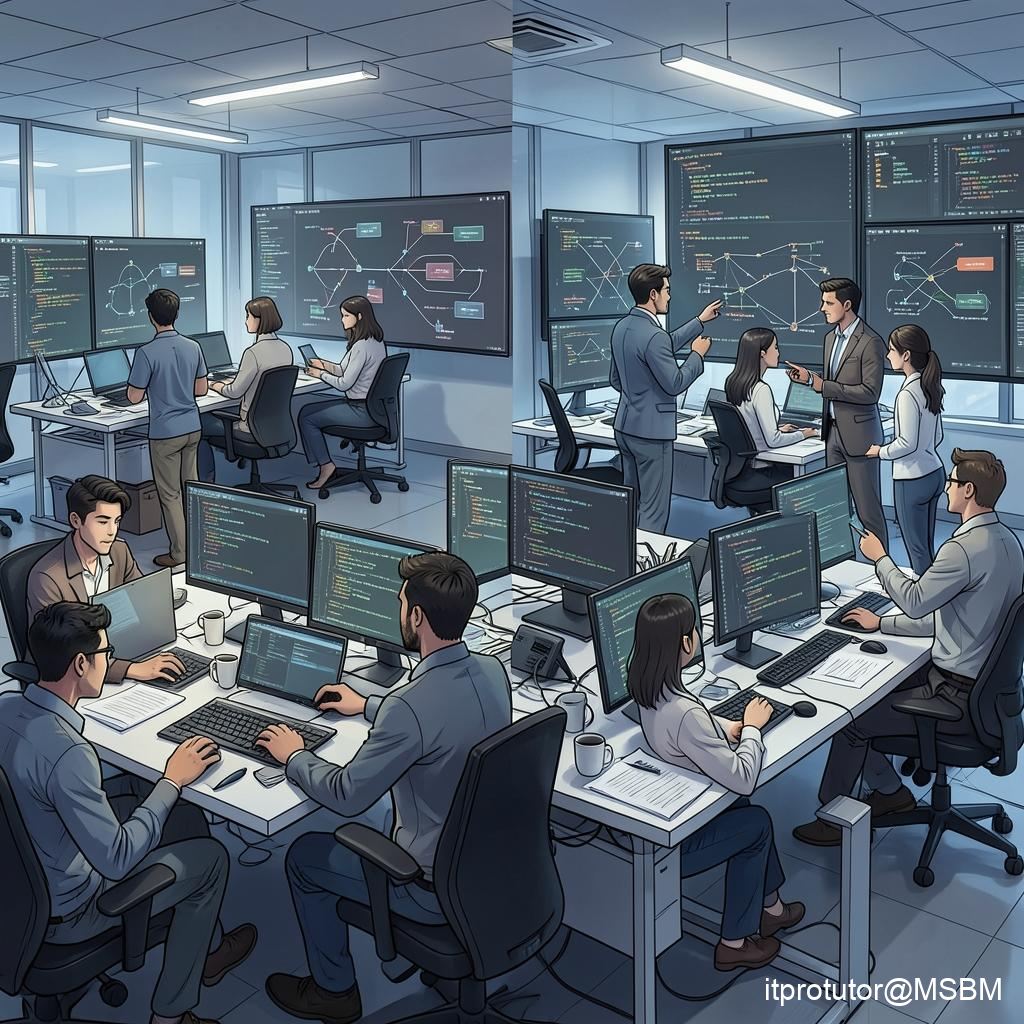
AI didn’t kill software engineering; it simply executed those who were never engineers to begin with, but mere syntax translators.
The rise of generative AI has made one reality brutally apparent: if your daily value relies on stitching together Stack Overflow snippets, writing routine boilerplate, or prompting an LLM to generate CRUD endpoints, your marginal economic utility is rapidly approaching zero. Generative models excel at the *accidental complexity* of software—the typing, the syntax, the common patterns. Where they hallucinate and fail catastrophically is at the boundary of *essential complexity*: systems design, resource constraints, and distributed realities.
Joel Spolsky’s **Law of Leaky Abstractions** has never been more relevant: *”All non-trivial abstractions, to some degree, are leaky.”* When AI-generated code inevitably hits production scale, who diagnoses the memory fragmentation in an unmanaged runtime? Who designs for data partition tolerances under the **CAP theorem**, handles cache invalidation stampedes, or identifies a silent thread starvation bug inside an event loop?
An AI can write a microservice in seconds, but it cannot conceptualize Conway’s Law, negotiate trade-offs between eventual consistency and latency, or design resilient failure domains across multi-region clusters. Engineers who understand memory hierarchies, kernel I/O models, and distributed consensus mechanisms thrive today because they are the only ones capable of evaluating, constraining, and debugging what the machines produce.
Fred Brooks asserted decades ago in *No Silver Bullet* that the hardest part of building software is the conceptual formulation of complex entities, not the syntactic implementation. We are moving from the era of the “Coder” to the era of the “Architect-Inspector.”
*Critique & Discussion:*
If the barrier to code generation has dropped to zero, what is your team doing to validate architectural integrity? When an AI delivers clean-looking code that subtly violates your ACID guarantees under peak concurrency, does your engineering culture possess the depth to catch it in review—or are you blindly deploying operational liabilities?
—
AI 並沒有摧毀軟體工程,它只是無情地淘汰了那些從未真正理解底層架構、僅充當「語法翻譯機」的搬運工。
生成式 AI 的普及揭示了一個殘酷的事實:如果你的核心競爭力建立在複製貼上程式碼片段、串接既成 API,或是依賴 AI 生成標準 CRUD 樣板,你的邊際經濟價值正在加速歸零。AI 擅長處理軟體工程中的「偶然複雜性」(Accidental Complexity)——語法結構、典型演算法與樣板撰寫;但當面臨「本質複雜性」(Essential Complexity)——系統拓撲、高併發調優與分散式架構權衡時,AI 往往陷入幻覺與架構失能。
軟體大師 Joel Spolsky 曾提出著名的**「抽象洩漏法則」(Law of Leaky Abstractions)**:「所有重大的抽象機制,在某種程度上都是漏洞百出的。」當 AI 產出的程式碼在高負載的生產環境中運作時,誰來排查記憶體洩漏與碎片化?誰來在 **CAP 定理**的架構限制下權衡一致性與可用性?面對連線池枯竭(Connection Pool Exhaustion)與快取雪崩,依賴提示詞的開發者只能束手無策。
正如 Fred Brooks 在《沒有銀彈》中所言,軟體建構最艱鉅的任務在於概念結構的塑模,而非敲打鍵盤的語法實現。AI 時代淘汰的是「語法打字員」,卻極大化了精通系統架構、作業系統 I/O 模型與分散式共識機制之「架構檢驗師」的價值。
*反思與探討:*
當程式碼生成的邊際成本降為零,你的團隊如何把關系統架構的穩健性?當 AI 產出看似架構整潔、卻在高併發下悄然破壞資料一致性的代碼時,你的團隊是否有足夠的底層技術底蘊在 Code Review 中將其攔截,還是正盲目地將未爆彈推向生產環境?
#SoftwareArchitecture #DistributedSystems #AIFutureOfWork #ITProTutor