
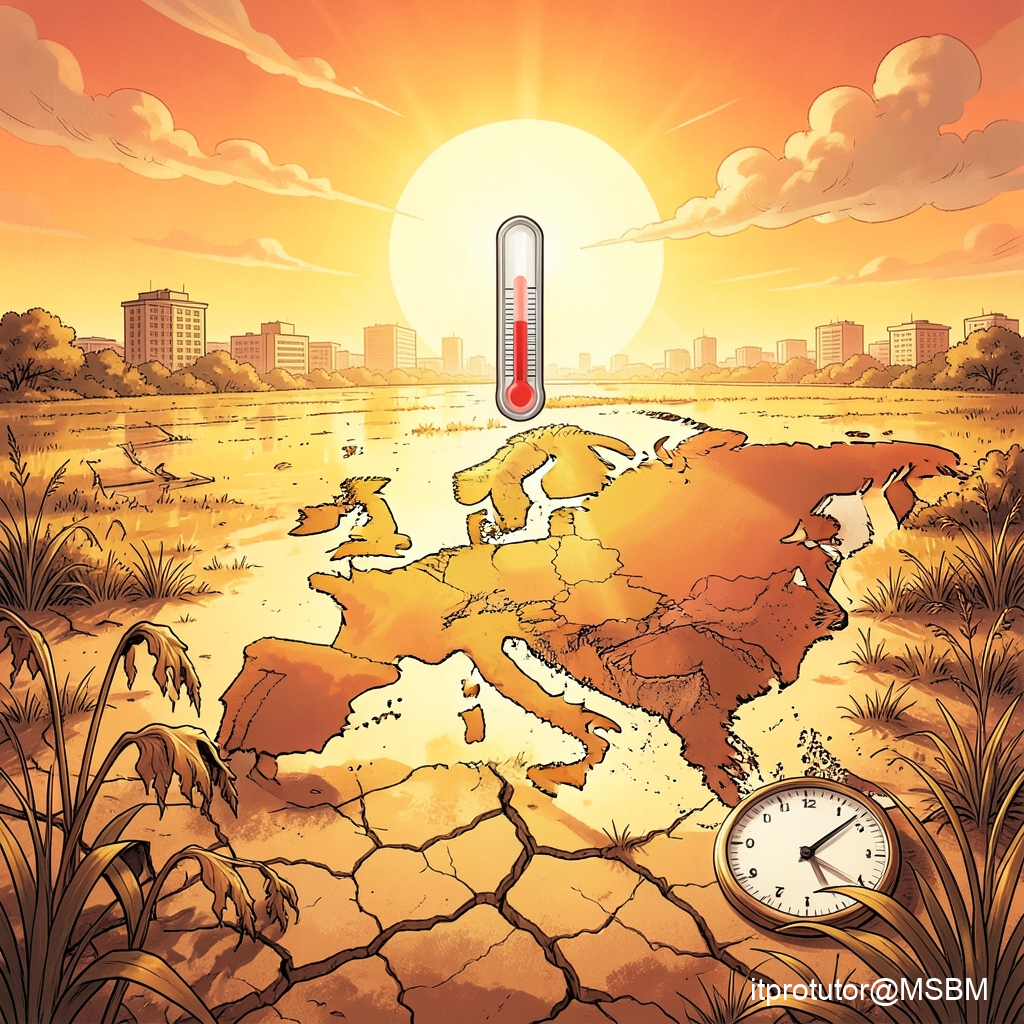
Are our predictive algorithms failing us, or are we witnessing a critical system-level overflow in the planet’s climate architecture?
Recent records show Europe, the United States, and Asia enduring unprecedented heatwaves, with models indicating that upcoming El Niño dynamics could push extreme temperatures even higher. Treating Earth as a massive distributed system, we are currently observing severe hardware resource contention and thermal throttling driven by greenhouse gas inputs.
Applying Chaos Theory and System Dynamics, minor thermal anomalies in ocean currents act like unhandled micro-exceptions in complex code, cascading into global operational failures. As IT professionals building next-generation infrastructure, this raises vital questions: Are we merely logging climate data, or are we engineering system resiliency for high-temperature operational environments? When our primary physical layer—the planet—fails its thermal specification tests, how must our data centers, algorithmic models, and edge devices evolve to maintain uptime? Share your technical perspectives below.
—
我們的預測演算法是否正面臨系統溢位(System Overflow)?全球氣候硬體已然進入極端過熱狀態!
最新數據顯示北半球正遭遇史無前例的酷熱考驗,歐美及亞洲多地氣溫刷新歷史紀錄,而聖嬰現象更可能將危機推向新高峰。從資訊系統架構的角度來看,這意味著地球正因溫室氣體過載而面臨嚴重的資源爭用與熱節流(Thermal Throttling)。
引用「系統動力學」與「混沌理論」,海洋溫度的微小擾動如同程式碼中未處理的異常(Exceptions),最終引發全球級的連鎖系統崩潰。作為建構下一代基礎設施的科技從業人員,我們必須深思:我們只是將氣候變遷視為單純的 Log 記錄,還是有在積極規劃高溫環境下的系統韌性?當底層硬體——地球本身——無法通過散熱測試時,我們的資料中心與演算法該如何調適?歡迎在下方留言討論!
#ClimateTech #SystemsThinking #DataAnalytics #ITProTutor
Source: MIT Technology Review
https://www.technologyreview.com/2026/08/13/1141788/summer-heat-el-nino/